What Is Reverse Brainstorming?
Reverse brainstorming is a problem-solving technique that asks how to make a situation worse before turning those failure ideas into solutions. It helps teams uncover risks, challenge assumptions, and generate practical improvements. This inverse approach of reverse brainstorming encourages deeper exploration of pain points and uncovers factors that might not emerge during conventional brainstorming.
Why Use Reverse Brainstorming?
Break Creative Blocks: Asking absurd or extreme “negative” questions shakes up mental routines, unlocking fresh perspectives that conventional brainstorming might miss.
Uncover Hidden Pain Points: Deliberately exploring how to worsen an outcome forces a detailed examination of failure modes, surfacing underlying issues, root causes, and latent risks that need attention.
Generate Diverse Solutions: A two-step process—negative ideation followed by inversion—yields a broader, more varied set of actionable options for problem-solving.
Boost Engagement: Teams engage in playful yet purposeful exploration, fostering collaboration and encouraging all participants to contribute without fear of judgment.
Find Opportunities for Improvement: Teams can identify quick wins for optimization and long-term strategies for resilience.

Reverse Brainstorming Examples Across Industries
Applying reverse brainstorming in different domains shows how the method adapts to different goals. Identify how to worsen a scenario, then invert each idea into a strategy tailored to the industry’s specific challenge.
| Use case | Reverse prompt | Positive inversion |
|---|---|---|
| E-commerce | How could we make checkout frustrating? | Show transparent pricing and simplify checkout. |
| Software development | How could we release unreliable code? | Add testing, documentation, and feedback loops. |
| Marketing | How could we make a campaign irrelevant? | Improve audience targeting and message relevance. |
| Human resources | How could we lose good employees? | Improve onboarding, development, recognition, and feedback. |
Retail & E-commerce
Negative Scenario: An online store could worsen conversions by adding hidden fees at checkout, using poor-quality images, or hiding customer reviews. They might also design a confusing, cluttered product listing that frustrates users.
Positive Inversion: This could be flipped by displaying transparent pricing, using high-resolution photos, streamlining navigation, simplified layouts, and featuring verified reviews prominently. Other inversion ideas might include AI-driven product recommendations to highlight top-selling items and one-click purchase options to enhance user experience.
Software Development
Negative Scenario: Teams imagine releasing untested code, delaying bug fixes, or lacking documentation. They may also introduce frequent bugs and slow release cycles.
Positive Inversion: Flipping these ideas leads to priorities like automated test suites, up-to-date technical documentation, continuous deployment, and rapid feedback loops. The inversion process may also surface solutions like code review checklists, error monitoring dashboards, and pair programming sessions to catch defects early.
Marketing Campaigns
Negative Scenario: Marketing teams might start by listing ways to destroy campaign performance like ignoring audience segmentation, overusing poor channels, or sending irrelevant messages.
Positive Inversion: Inverting these issues leads to tactics like hyper-targeted ads, using analytics to tailor content, and optimizing the channel mix. This systematic flip can reveal untapped opportunities like podcast sponsorships and fresh messaging angles grounded in customer pain points.
Human Resources
Negative Scenario: In HR, negative ideas include neglecting onboarding, refusing flexible work options, cutting off advancement paths, ignoring employee feedback, and restricting professional growth.
Positive Inversion: Robust orientation programs, remote-friendly policies, regular employee surveys, clear development plans, and mentorship programs are the result of inverting the negatives. Reverse brainstorming can also uncover retention risks such as a lack of recognition leading to solutions like peer-nominated awards, pulse surveys, and manager training on feedback delivery.
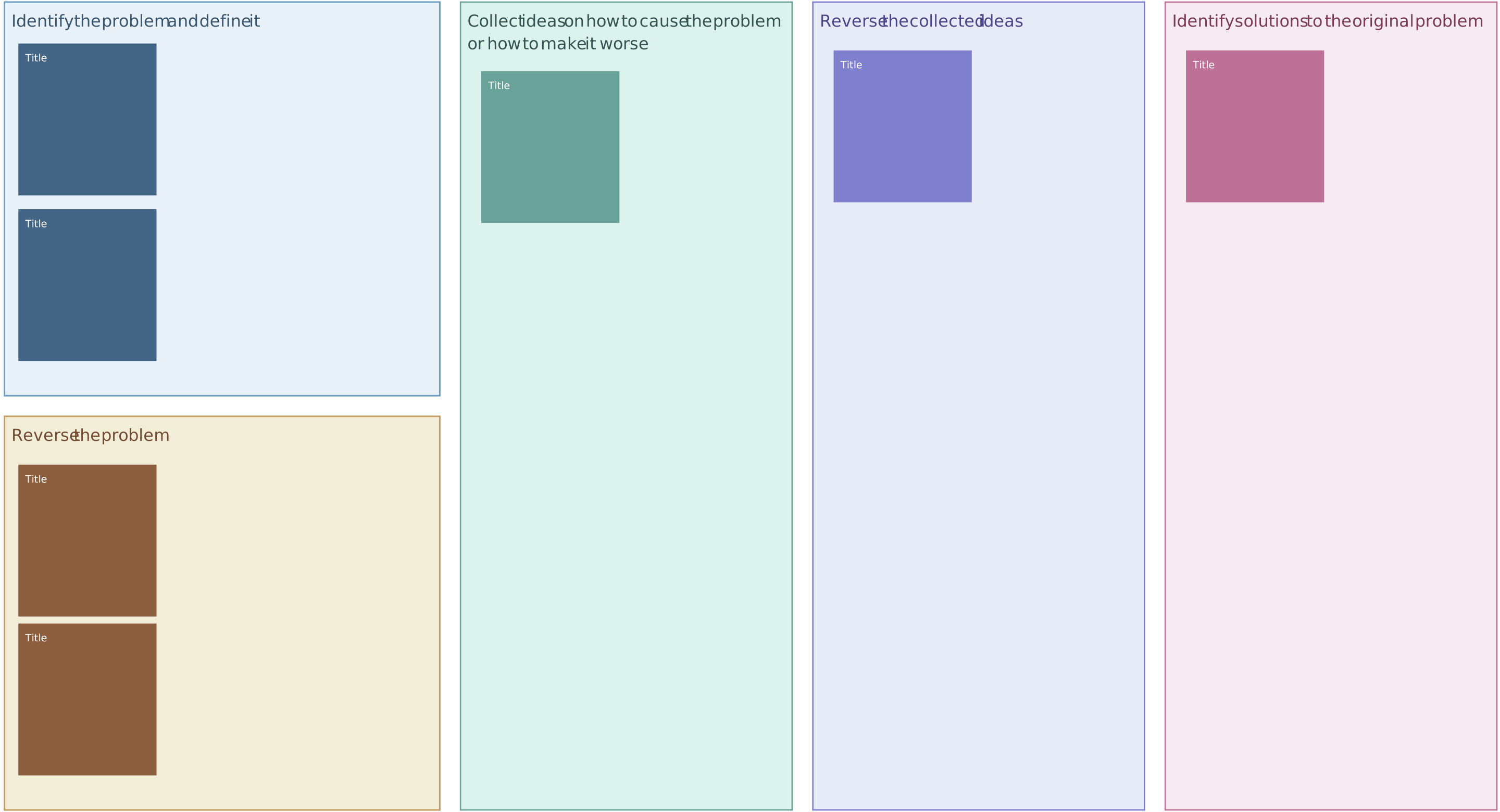
How to Reverse Brainstorm in Creately with an Example
This example shows how a team can improve customer onboarding by running a reverse brainstorming session in Creately.
Step 1: Open a Template and Define the Core Problem
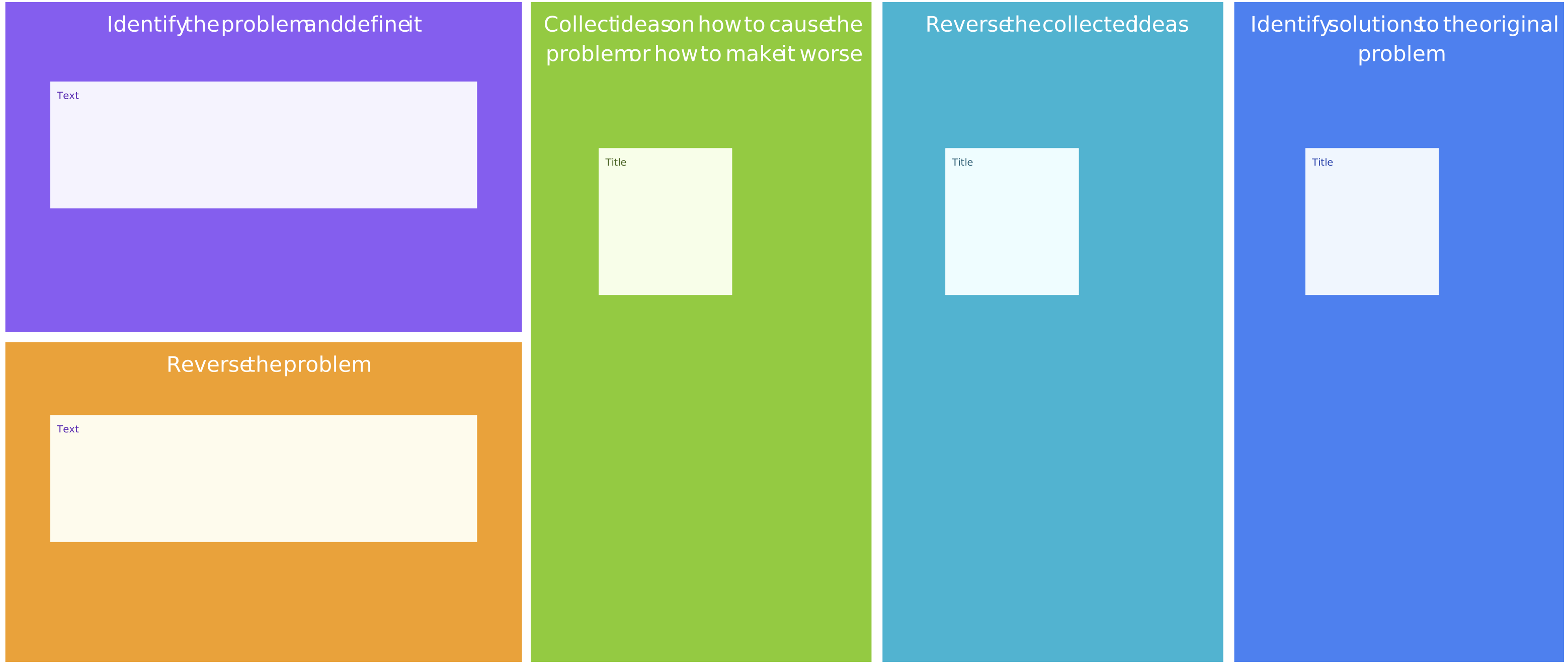
Start by selecting a reverse brainstorming template from Creately’s template library and inviting your team to the workspace. Align on a clear, focused problem statement, such as “How can we improve customer onboarding?” Use it to define the scope and context, then document the background, goals, and constraints on the template.
Step 2: Flip the Question
Reframe your problem into its opposite: “How can we make onboarding worse?” or “How could we frustrate new users?” Add this reversed prompt to the template to guide the session and shift thinking into a disruptive, but creative mode.
Step 3: Brainstorm Negative Ideas
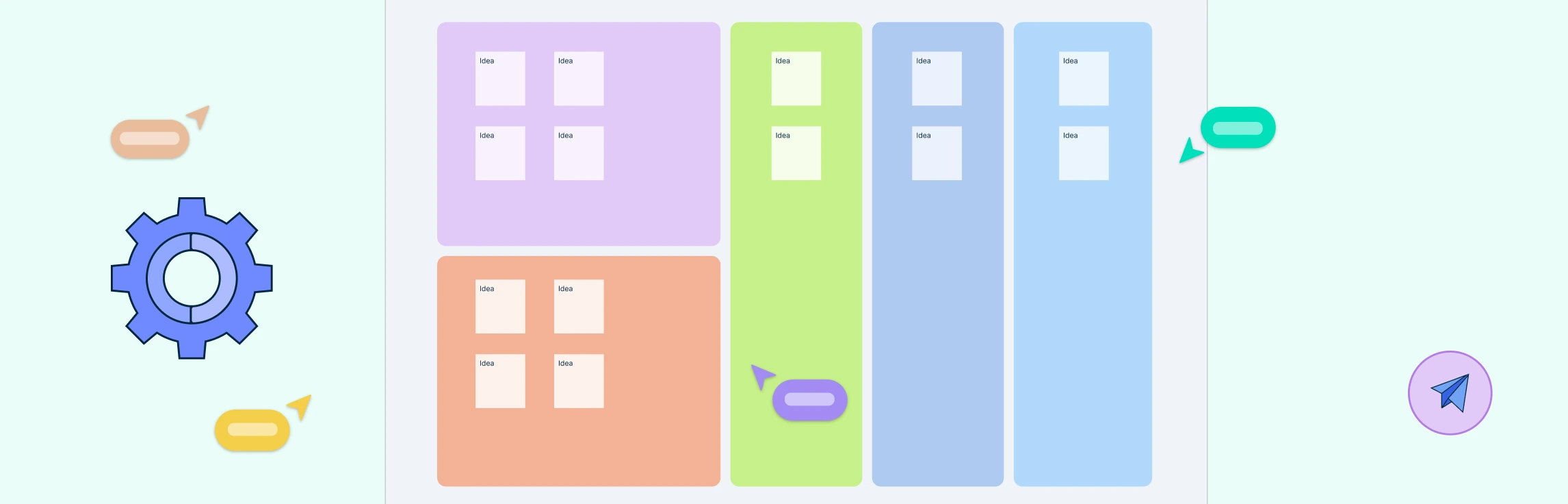
Encourage the team to get creative by listing every way to sabotage the experience. Use sticky notes or clusters in Creately to map out ideas like confusing interfaces or hidden costs. Don’t filter ideas and focus on volume and variety.
Step 4: Invert to Positive Solutions
Now flip each negative into a constructive solution. “Confusing interface” becomes “intuitive, guided UI.” Use color coding to link negatives with their positive inversions on the canvas.
Step 5: Use Creately’s AI Reverse Brainstorming Template
You could also use Creately’s AI reverse brainstorming template to speed up the steps above. This tool auto-generates reversed problem prompts and sample sabotage ideas based on your input. The suggested ideas can be used as a quick starting point to guide your team’s thinking during the reverse brainstorming session.
Step 6: Prioritize and Refine
Evaluate which inversions have the most impact and are feasible. Use Creately’s voting feature to get your team’s input. Refine your top picks, assign tasks to members, and plan next steps directly on the canvas.
Step 7: Share and Export Outcomes
Once the session wraps up, share the workspace with other stakeholders using view or edit links. Export the final board as a PDF, PNG, or embed it into docs and presentations. Use Creately’s version history and comment threads to track feedback and keep collaboration ongoing.
Free Reverse Brainstorming Templates By Creately


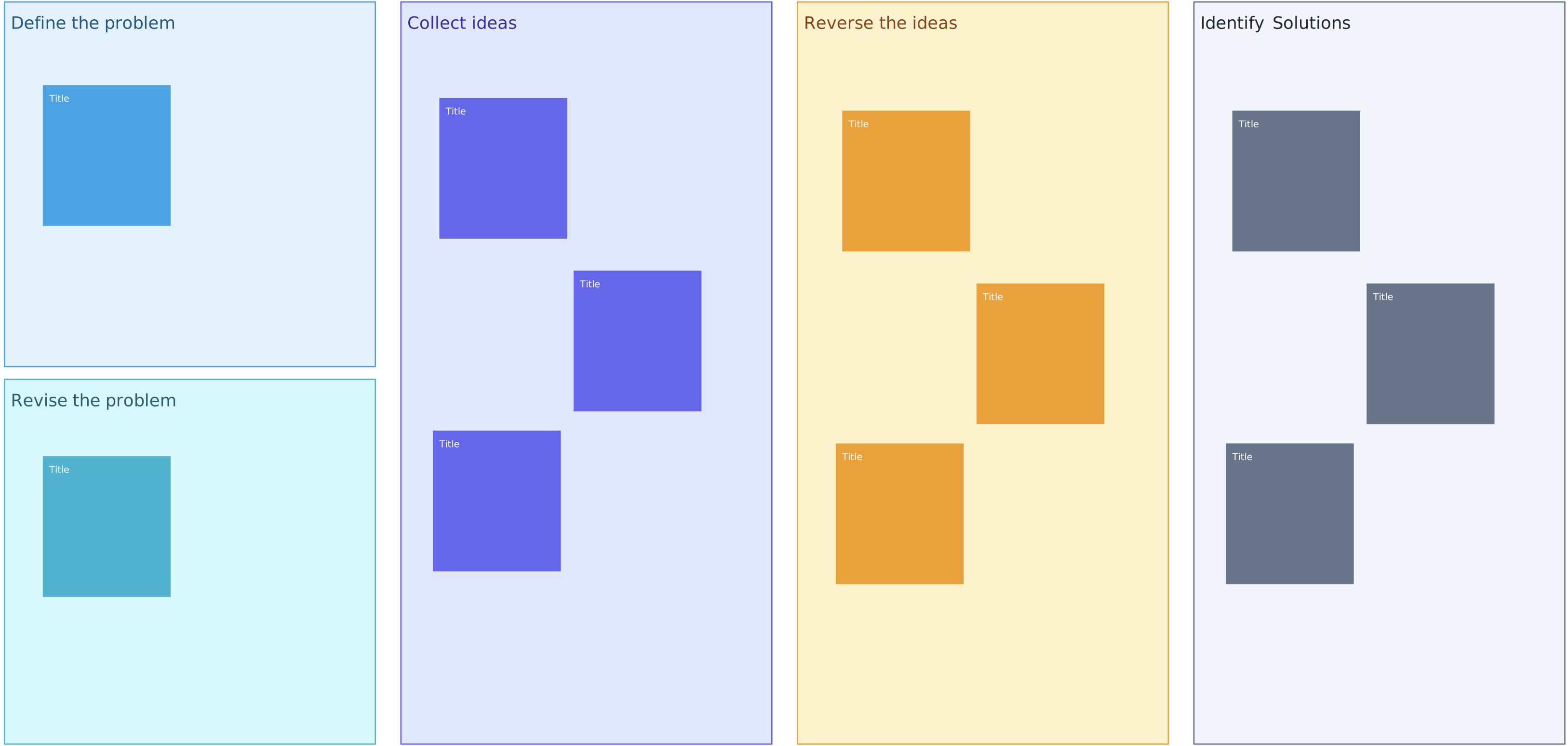
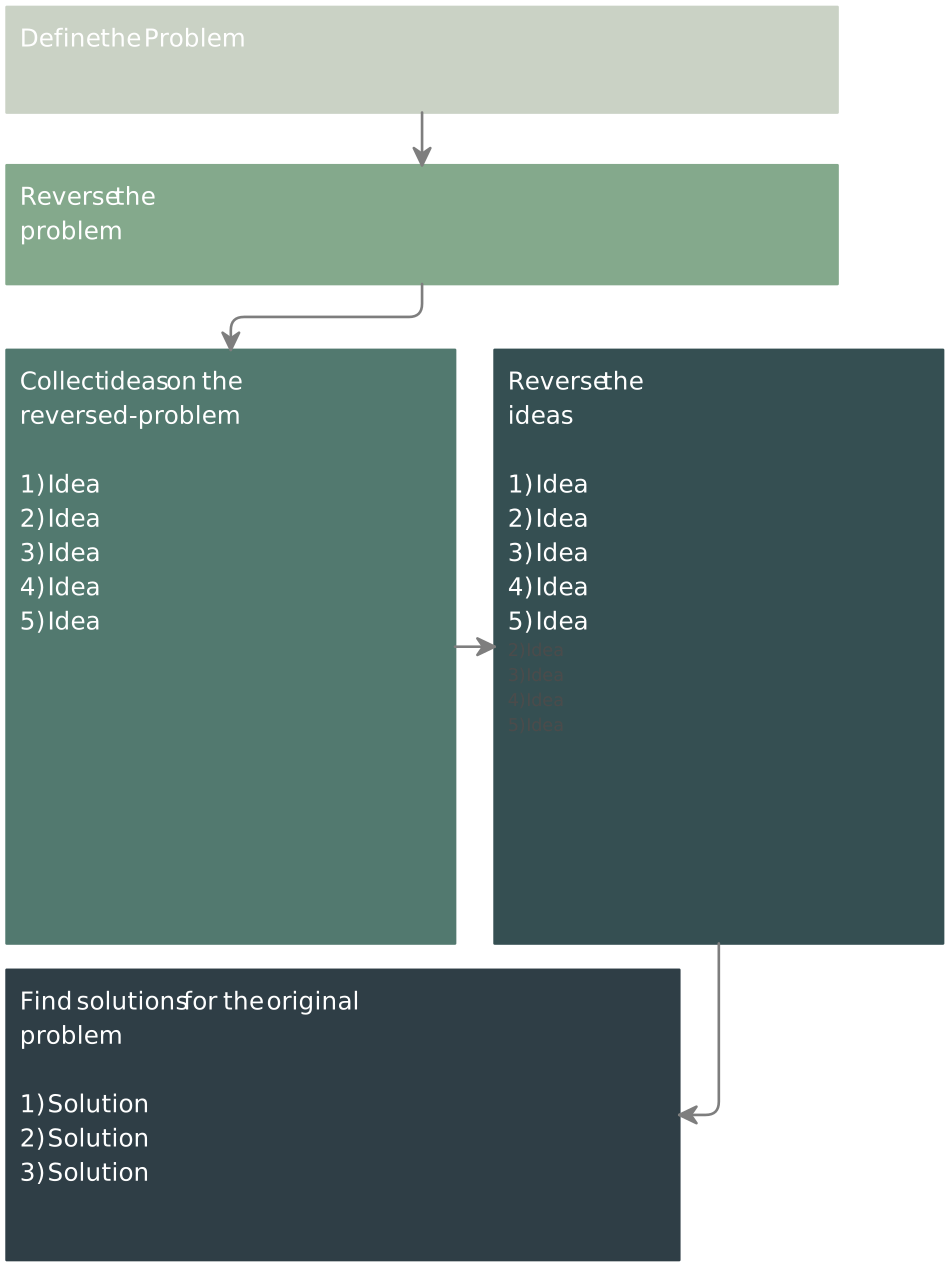
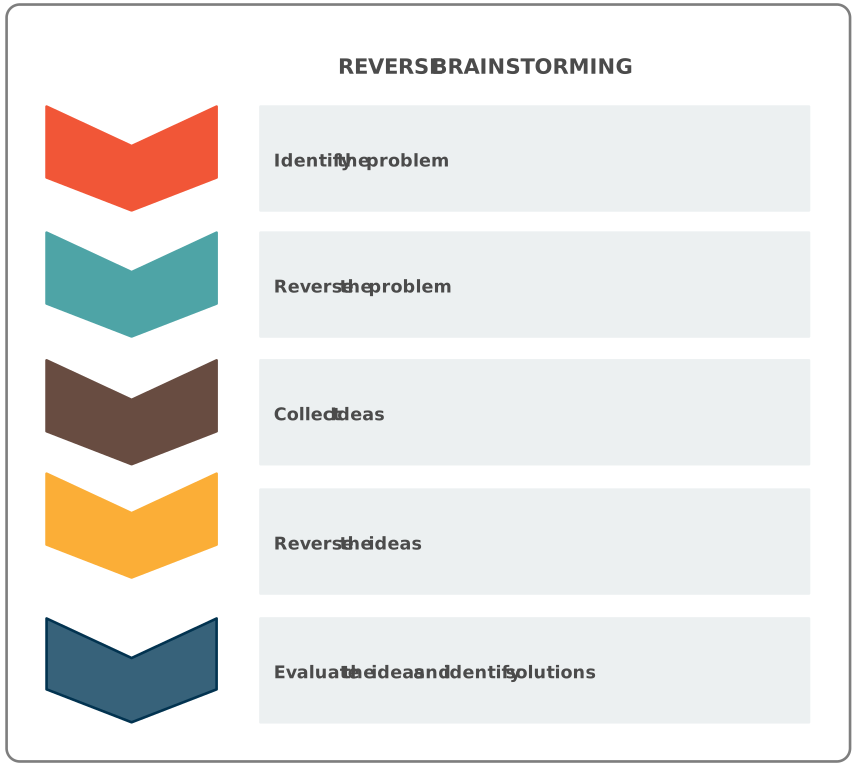
Helpful Resources for Reverse Brainstorming
Use this powerful AI-powered tool to brainstorm your ideas.
Learn the differences between reverse and traditional brainstorming.
Browse our community-designed collection of ready-to-use brainstorming templates.
FAQs about Reverse Brainstorming Examples
How can product teams use reverse brainstorming?
What’s an example of reverse brainstorming in customer service?
Is reverse brainstorming useful for startups?
What are quick example prompts to kick off reverse brainstorming?
- “How could we lose our best customers?”
- “What would make this totally unusable?”
- “How could we waste resources on this?”
What are best practices for reverse brainstorming?
- Invite a cross-functional team for diverse input (e.g., product, design, marketing).
- Time-box the session to keep ideas focused and energy high.
- Use a shared workspace like Creately to visualize and organize all ideas.
- Combine with tools like SWOT to assess and prioritize inverted solutions.
- Schedule follow-ups to prototype, assign ownership, and refine top ideas.
Resources
Hagen, Marcia, et al. “Do It All Wrong! Using Reverse-Brainstorming to Generate Ideas, Improve Discussions, and Move Students to Action.” Management Teaching Review, vol. 1, no. 2, 16 Mar. 2016, pp. 85–90, https://doi.org/10.1177/2379298116634738.
Hicks, Michael J. “Brainstorming.” Problem Solving in Business and Management, 1991, pp. 87–107, https://doi.org/10.1007/978-1-4899-7148-7_6. Accessed 8 July 2025.
Wilson, Chauncey E. “Inverse, Reverse, and Unfocused Methods.” Interactions, vol. 14, no. 6, 1 Nov. 2007, p. 54, https://doi.org/10.1145/1300655.1300687. Accessed 19 Mar. 2020.