What Is Reverse Thinking
Reverse thinking is a problem-solving approach derived from classical inversion logic. Instead of pursuing direct solutions, you simply flip challenges on their head, asking: “How could this fail?” or “What would make this worse?” This method uncovers hidden assumptions and unseen risks that traditional forward thinking often overlooks.
It’s important to distinguish between three closely related but distinct techniques:
- Reverse Thinking: The overarching process of “Thinking in Reverse”—starting at the finish line to map the most efficient path to the start.
- Reverse Brainstorming: A specific subset of reverse thinking where you brainstorm ways to cause a problem in order to find better ways to solve it.
- Inversion: A mental model (popularized by Charlie Munger) that focuses on “avoiding stupidity” rather than “seeking brilliance” by identifying everything that could go wrong.
Why Reversal Thinking Works
Understanding common mistakes leads to continuous process improvement and resource optimization. Instead of allocating time chasing marginal gains, teams redirect efforts toward eliminating systemic weaknesses. Benefits of thinking in reverse include,
- Risk Reduction: Early identification and mitigation of vulnerabilities reduces costly rework.
- Resource Optimization: Teams allocate budget and time to prevent the highest impact failures.
- Enhanced Resilience: Systems and strategies built on avoided errors withstand unexpected challenges.
- Process Improvement: Continuous feedback loops emerge by analyzing near-misses and failure scenarios.
Practical Reverse Thinking Examples for Modern Teams
Using reverse thinking examples helps teams bypass traditional linear biases and uncover non-obvious solutions. By thinking in reverse, you start with the end state—or a specific failure—to map out a more resilient path forward.
1. Software Development: The “Antifragile” Code Review
In software engineering, teams use the reverse thinking technique to improve system architecture. Instead of just planning new features, developers imagine the system has already crashed in production.
- The Reverse Question: “What is the most likely reason our server just went down?”
- The Action: By analyzing the “crash” backward, teams identify hidden bottlenecks in code quality and technical debt that linear planning often overlooks.
2. Marketing Strategy: The “Unsuccessful Campaign” Inversion
Rather than simply aiming for high engagement, marketers apply thinking in reverse by analyzing why a target audience would ignore an ad.
- The Reverse Question: “Why did our potential customers scroll past this without clicking?”
- The Action: This identifies “friction points” like confusing messaging or poor visual hierarchy, allowing for more effective targeting and refined customer engagement.
3. Customer Service: Proactive Friction Mapping
In customer support, reverse thinking shifts the focus from “handling tickets” to “eliminating tickets.” Teams identify the most frustrating common complaints and work backward to the source.
- The Reverse Question: “What is the #1 thing that makes a customer want to cancel their subscription today?”
- The Action: Identifying these deal-breakers leads to proactive UX changes and better onboarding, ultimately enhancing overall satisfaction.
4. Risk Management: The Strategic “Pre-Mortem”
Organizations use reversal thinking in risk assessment by starting at the “point of failure.” They imagine a project has failed to meet its compliance or financial goals.
- The Reverse Question: “It is one year from now, and we have gone bankrupt; what specific event caused it?”
- The Action: This identifies external threats and internal vulnerabilities, enabling teams to develop robust contingency plans and mitigation strategies.
5. Project Management: Budget & Schedule Deconstruction
Project managers enhance efficiency by thinking in reverse during the planning phase. They visualize a project that has run over budget and schedule.
- The Reverse Question: “Where did the ‘scope creep’ start that led to this delay?”
- The Action: By understanding the root causes of overruns from a hypothetical end-point, managers can implement tighter monitoring and better resource allocation from Day 1.
How to Apply Reverse Thinking in Practice
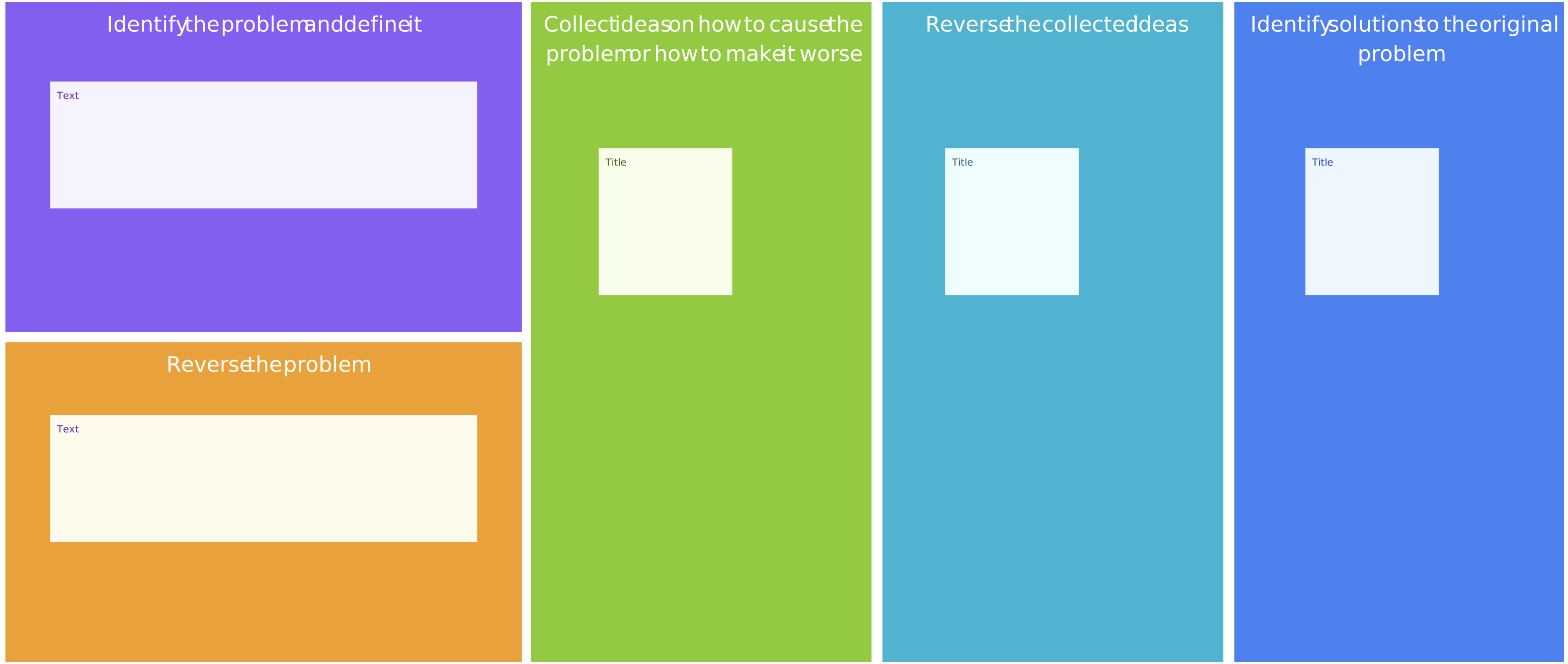
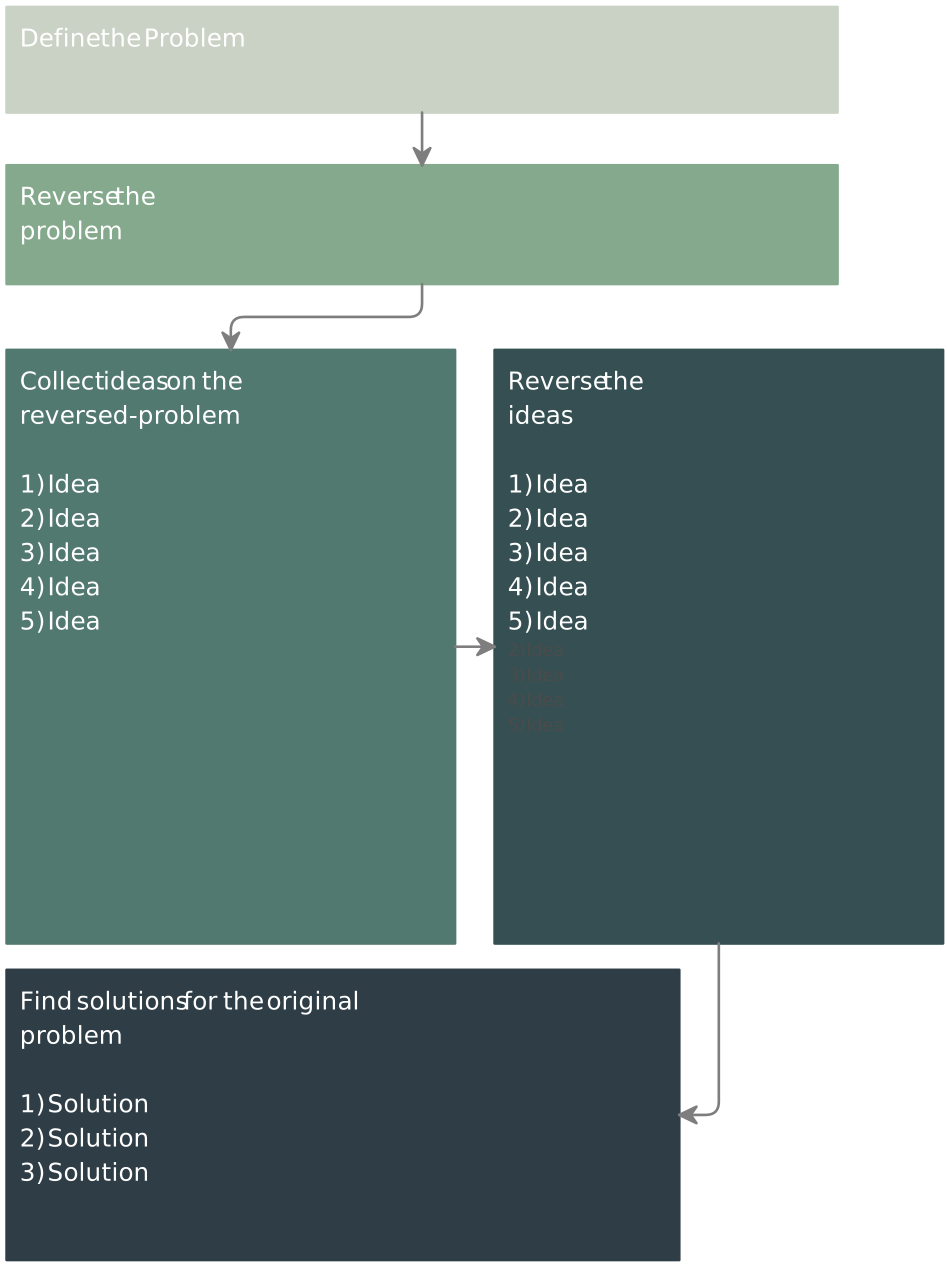
The reverse thinking concept is applied in practice by professionals through the structured and collaborative technique known as reverse brainstorming. In this method, teams generate ideas on how to cause or worsen a problem. Once these negative scenarios are established, participants invert each item to derive the solutions.
Reverse brainstorming can uncover unconventional remedies that standard brainstorming misses. To apply the reverse thinking technique practically,
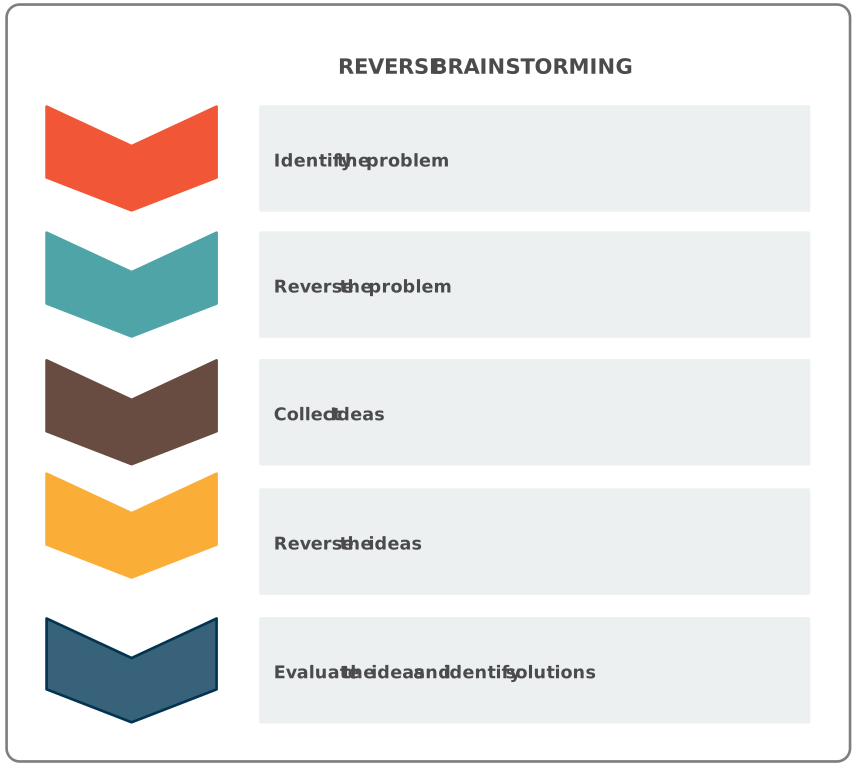
- Step 01 - Identify the problem: Clearly define the problem you want to solve.
- Step 02 - Generate problem-enhancing ideas: Encourage brainstorming participants to think of actions or ideas that worsen the problem.
- Step 03 - Reverse the ideas: Take the problem-enhancing ideas and flip them into potential solutions.
- Step 04 - Evaluate and refine: Analyze the reversed ideas for their creative potential and feasibility.
- Step 05 - Select the best ideas: Choose the most promising solutions for implementation.
Challenges in Reversal Thinking and How to Overcome Them
| Challenge | Reason | How to Overcome It |
|---|---|---|
| Getting Comfortable with the Method | The reverse thinking technique can feel unnatural. Mental blocks, fear of judgment, and discomfort can limit participation. | - Run warm-up or low-pressure sessions - Encourage a judgment-free zone - Use humor and embrace “bad” ideas as part of the process |
| Misalignment on the Problem | Teams may start without clearly defining what problem is being reversed, leading to confusion. | - Start with a clearly phrased reversed problem (e.g., “How can we make this worse?”) - Combine with traditional brainstorming for balanced solutions |
| Limited Participation and Groupthink | Dominant voices may control the session, and others may conform, reducing idea diversity. | - Use structured participation (round-robin brainstorming, anonymous submission) - Rotate facilitators for fresh perspectives - Encourage open-mindedness and inclusivity |
| Fixating on Constraints Too Early | Worrying about feasibility or limitations too soon can block creative ideas. | - Promote divergent thinking during idea generation - Delay feasibility evaluation until after brainstorming ends |
| Lack of Follow-Through | Great ideas can be lost if not reviewed for practicality or next steps. | - Post-session, assess ideas for feasibility, resources, and impact - Prioritize actionable concepts for implementation |
Free Brainstorming Examples for Reversal Thinking By Creately



Reverse thinking is more than just a creative exercise; it is a strategic necessity for teams looking to de-risk their projects and uncover non-linear solutions. Whether you are deconstructing a software crash or mapping a marketing funnel, starting at the finish line provides a clarity that forward-thinking often misses. Ready to flip your perspective? Try Creately’s reverse brainstorming templates to visualize your risks, collaborate in real-time, and turn your obstacles into actionable breakthroughs.
Helpful Resources for Reverse Thinking
Use this powerful AI-powered tool to brainstorm your ideas.
Learn how reverse brainstorming is used with examples across industries.
Browse our community-designed collection of ready-to-use brainstorming templates.
FAQs About Reverse Thinking
What is the main difference between reverse thinking and reverse brainstorming?
Why is reverse thinking powerful?
Is reverse thinking suitable for all teams or industries?
Do I need special tools or training to run a reverse thinking session?
How can I ensure that the reversed ideas are realistic and not too far-fetched?
Resources
Hirashima, Tsukasa, and Megumi Kurayama. “Learning by Problem-Posing for Reverse-Thinking Problems.” Lecture Notes in Computer Science, vol. vol 6738, 2011, pp. 123–130, https://doi.org/10.1007/978-3-642-21869-9_18.
Wilson, Chauncey E. “Inverse, Reverse, and Unfocused Methods.” Interactions, vol. 14, no. 6, 1 Nov. 2007, p. 54, https://doi.org/10.1145/1300655.1300687.